


Sunscreen for Combination Skin: A Beginner's Guide for Summer
Ask ten people with combination skin what sunscreen they use, and you'll probably get ten different answers, half of them frustrated. That's because combination skin doesn't behave like a single skin type. It behaves like two skin types stuck together, and most sunscreen labels don't account for that at all.
If you've never really understood why your regular sunscreen either breaks you out around the nose or leaves your cheeks feeling chalky, this guide walks through the basics — what combination skin actually is, why summer makes it trickier, and what to look for when you shop for sunscreen for combination skin in summer.
What Combination Skin Really Means##
Combination skin isn't a vague label dermatologists use loosely. It refers to skin that produces more oil in the T-zone — forehead, nose, and chin — while the cheeks and jaw stay comparatively dry or normal. Around 40 to 45 percent of people are estimated to fall into this category, according to dermatology literature, which makes it one of the most common skin types, not a rare exception.
The tricky part is that skincare products are usually developed with a single skin type in mind. Oily skin sunscreens tend to be alcohol-heavy and mattifying. Dry skin sunscreens lean thick and creamy. Combination skin sits right in between, and needs a formula that doesn't fully commit to either extreme.
Why Summer Changes the Equation
Heat and humidity don't affect all parts of your face equally. The T-zone, already prone to oil, produces even more sebum as temperatures rise. Meanwhile, sun exposure and sweating can dehydrate the cheeks further, especially if you're moving between air-conditioned spaces and the outdoors multiple times a day, which is fairly normal for anyone commuting to work or college.
This is why summer sunscreen shopping deserves more thought than winter sunscreen shopping. A formula that felt fine in December can suddenly feel heavy and pore-clogging by April.
The Basics of SPF and PA You Should Know
Before picking a product, it helps to understand two terms printed on almost every sunscreen bottle.
SPF (Sun Protection Factor) tells you how well a sunscreen protects against UVB rays, which cause sunburn and contribute to skin cancer risk over time. SPF 30 blocks close to 97 percent of UVB rays; SPF 50 blocks around 98 percent.
PA rating measures protection against UVA rays, which penetrate deeper and are linked to premature ageing, fine lines, and pigmentation. The rating scale runs from PA+ to PA++++, with more plus signs meaning stronger protection.
For daily use in Indian summer conditions, dermatologists commonly suggest SPF 30–50 with at least PA+++, paired with a broad spectrum label confirming both UVA and UVB coverage.
Choosing a Texture That Works for Both Zones
This is where most people go wrong. They either chase a mattifying sunscreen because their T-zone bothers them, or they chase a hydrating one because their cheeks feel dry, without considering the whole face.
A few texture categories to know:
Gel-based sunscreens absorb fast and leave minimal residue, generally suiting the T-zone well. Water-based fluids offer a middle ground — light enough for oily areas, hydrating enough for drier ones. Cream-based sunscreens work better for people whose dryness outweighs their oiliness, though they can feel heavy on the T-zone in peak summer.
Many combination skin users find that a fluid or gel-cream hybrid gives the best overall balance, since it doesn't force a compromise on either zone.
Ingredients Worth Knowing
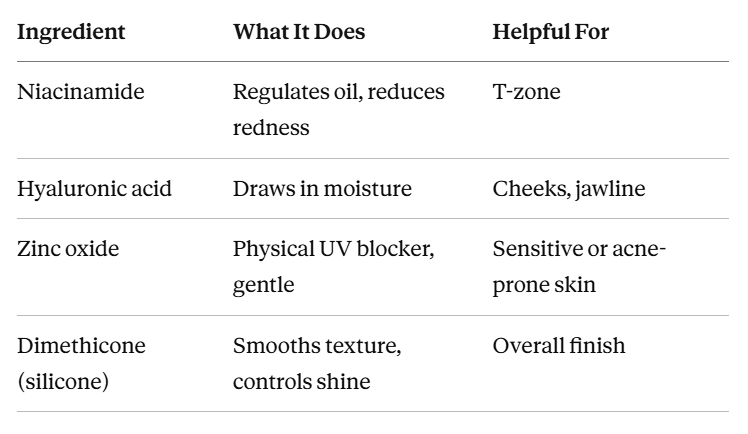
Avoid sunscreens loaded with coconut oil or heavy mineral oil if your T-zone is already prone to congestion — these tend to make breakouts more likely during humid months.
A Simple Way to Test If a Sunscreen Suits You
Apply it in the morning and check your face at three points during the day: mid-morning, early afternoon, and evening. If your T-zone is shiny within two hours but your cheeks still feel comfortable, the formula is probably too heavy overall. If your cheeks feel tight by afternoon while your T-zone is fine, it's likely too mattifying. A sunscreen that keeps both zones reasonably balanced through most of the day is usually a good match.
Key Takeaways##
- Combination skin needs a sunscreen that doesn't fully lean into oil control or hydration alone.
- SPF 30–50 with PA+++ or higher is a reasonable standard for Indian summer.
- Gel and fluid textures tend to suit combination skin better than heavy creams.
- Ingredients like niacinamide and hyaluronic acid can help address both zones at once.
- Testing a sunscreen across a full day tells you more than reading the label alone.
Conclusion##
Understanding your skin's dual nature is really the first step toward better sun protection. Once you know what combination skin needs — a formula that doesn't overcorrect for either oiliness or dryness — shopping for sunscreen for combination skin in summer becomes a lot less overwhelming, and a lot more about matching your skin's actual behaviour instead of guessing.
FAQs##
Q1. What percentage of people have combination skin? Dermatology estimates suggest roughly 40 to 45 percent of people fall into the combination skin category, making it one of the more common skin types rather than an unusual one.
Q2. Does combination skin change with age? It can. Oil production in the T-zone often decreases with age, so some people notice their skin shifting toward normal or dry over time, particularly after their thirties.
Q3. Is SPF 30 enough for combination skin in summer? SPF 30 offers solid protection for short outdoor exposure, though SPF 50 is often preferred for extended time outdoors during peak Indian summer months.
Q4. Can I use the same sunscreen on my body and face if I have combination skin? Facial sunscreens are usually formulated for finer skin and are less likely to clog pores, so it's generally better to use a separate, lighter formula on the face.
Q5. How do I know if my sunscreen is too heavy for my T-zone? If you notice visible shine or small bumps forming around your nose and forehead within a couple of hours of application, the formula is likely too rich for that zone.
All rights reserved
