


[Salesforce Agentforce Sales Consultant 2026] Phần 3 — Consulting & Implementation Strategies (25%): Từ Business Requirement Đến Salesforce Solution
Ở Phần 2, chúng ta đã đi qua Sales Lifecycle và hiểu cách một doanh nghiệp vận hành từ Marketing, Lead, Opportunity cho đến Closed Won / Closed Lost, Forecast và Analytics.
Nhưng hiểu Sales Process mới chỉ là bước đầu.
Khi tham gia một dự án Salesforce thực tế, khách hàng hiếm khi nói:
“Hãy tạo cho tôi một Record-Triggered Flow trên Opportunity.”
Thứ chúng ta thường nhận được sẽ giống như:
“Sales Rep đang mất quá nhiều thời gian follow-up khách hàng.”
“Management không tin số liệu Forecast.”
“Salesforce đã triển khai nhưng Sales Team không chịu sử dụng.”
“Mỗi Region đang có một Sales Process khác nhau.”
Đây đều là Business Problems, chưa phải Salesforce Solutions.
Nhiệm vụ của Consultant là biến những Business Problems đó thành một Solution có thể triển khai.
Mental Model của Phần 3:
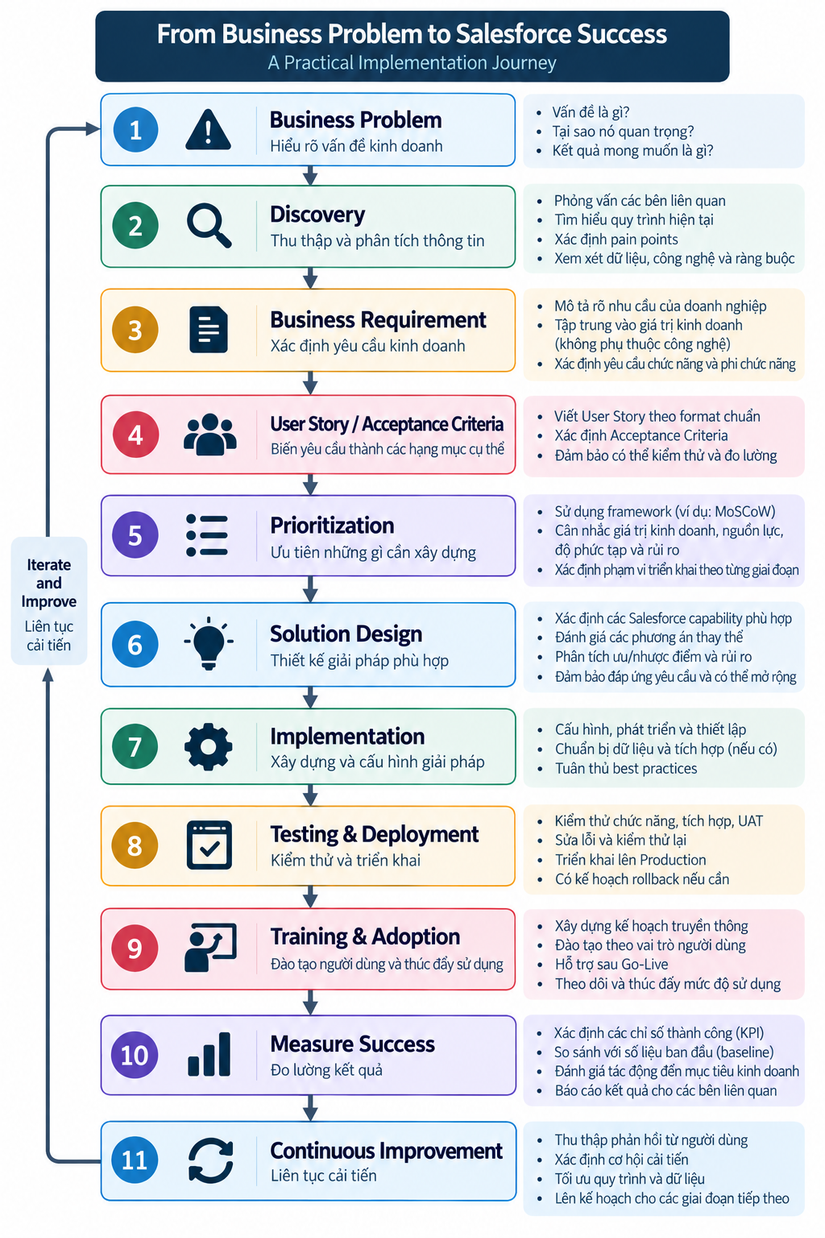
Đây cũng chính là bước chuyển lớn nhất từ tư duy Administrator sang Consultant:
Administrator thường được hỏi “How do we configure it?”
Consultant phải tìm ra “What should we build, why should we build it, and how do we know it succeeded?”
1. Discovery — Đừng thiết kế Solution quá sớm
Giả sử Sales Director nói:
“Tôi muốn Salesforce tự động Follow-up Lead.”
Phản xạ đầu tiên có thể là:
Flow.
Nhưng đó là một sai lầm phổ biến.
Chúng ta chưa biết:
- Lead nào cần Follow-up?
- Follow-up sau bao lâu?
- Email hay Call?
- Sales Rep hay hệ thống thực hiện?
- Nếu Lead phản hồi thì sao?
- Nếu Lead không phản hồi thì sao?
- Có nhiều Sales Teams với quy trình khác nhau không?
- Business Outcome mong muốn là gì?
Consultant cần thực hiện Discovery trước khi thiết kế Solution.
Discovery có thể bắt đầu bằng những câu hỏi:
Business
- Business Problem hiện tại là gì?
- Tại sao vấn đề này quan trọng?
- Business Outcome mong muốn là gì?
- KPI nào được sử dụng để đo thành công?
Process
- Quy trình hiện tại diễn ra như thế nào?
- Ai tham gia?
- Có những exception nào?
- Bottleneck nằm ở đâu?
Users
- Ai sẽ sử dụng Solution?
- User Groups nào có nhu cầu khác nhau?
- Người dùng hiện đang gặp khó khăn ở đâu?
Data
- Data hiện nằm ở đâu?
- Data Quality như thế nào?
- Có duplicate hoặc missing data không?
- Có External Systems nào liên quan không?
Technology
- Salesforce hiện đang được cấu hình như thế nào?
- Có Automation nào đang tồn tại?
- Có Integration hoặc AppExchange Solution nào không?
- Có Technical Constraint nào cần xem xét?
Điểm quan trọng:
Discovery không phải là hỏi khách hàng muốn Salesforce Feature nào.
Discovery nhằm hiểu:
Business thực sự đang cố gắng giải quyết vấn đề gì?
2. Stakeholders — Hỏi đúng người quan trọng không kém hỏi đúng câu
Một dự án Sales Cloud có thể liên quan đến nhiều Stakeholders.
Ví dụ:
| Stakeholder | Điều họ quan tâm |
|---|---|
| VP Sales | Revenue, Forecast, Pipeline |
| Sales Manager | Team Performance, Pipeline Review |
| Sales Rep | Productivity, Ease of Use |
| Marketing | Lead Quality, Campaign Performance |
| Sales Operations | Process, Data Quality, Reporting |
| IT | Security, Integration, Architecture |
| Executive Sponsor | ROI, Adoption, Business Outcome |
Một lỗi phổ biến là chỉ Discovery với Management.
Ví dụ VP Sales nói:
“Salesforce đang hoạt động tốt, chỉ cần cải thiện Forecast.”
Nhưng khi nói chuyện với Sales Reps, Consultant phát hiện:
Sales Rep phải nhập cùng một thông tin vào 15 Fields.
Kết quả:
Poor User Experience → Low Adoption → Incomplete Opportunity Data → Unreliable Forecast
Vấn đề Forecast thực chất bắt nguồn từ User Experience và Adoption.
Đây là lý do Discovery phải có nhiều góc nhìn.
3. Current State và Future State
Một technique rất hữu ích trong Discovery là phân biệt:
Current State — AS-IS
Business đang hoạt động như thế nào hôm nay?
và:
Future State — TO-BE
Business muốn hoạt động như thế nào sau khi triển khai Salesforce?
Ví dụ:
AS-IS
Lead từ Website
      ↓
Marketing export CSV
      ↓
Gửi Email cho Sales Manager
      ↓
Manager phân Lead bằng Excel
      ↓
Sales Rep nhập Lead vào CRM
      ↓
Follow-up thủ công
Problems:
- Duplicate Data.
- Manual Work.
- Slow Lead Assignment.
- Không đo được Response Time.
- Không có Single Source of Truth.
TO-BE
Lead Capture
      ↓
Salesforce
      ↓
Qualification / Routing
      ↓
Assigned Sales Rep
      ↓
Structured Follow-up
      ↓
Opportunity
      ↓
Analytics
Nhưng hãy chú ý:
Future State không có nghĩa automate mọi thứ.
Consultant phải xác định bước nào:
- cần Automation;
- cần Human Decision;
- cần Approval;
- cần AI;
- hoặc không cần thay đổi.
4. Business Requirement ≠ Solution Requirement
Đây là distinction rất quan trọng.
Khách hàng nói:
“Chúng tôi cần một Flow để tự động assign Lead.”
Đây thực ra đã chứa một Solution.
Consultant nên quay lại Business Requirement:
New Leads cần được phân phối nhanh chóng đến Sales Rep phù hợp dựa trên Region.
Sau đó mới đánh giá Solution.
Có thể Solution là:
- Lead Assignment Rules.
- Flow.
- Territory-related logic.
- Custom Development.
- Hoặc combination của nhiều capability.
Mental Model:
Business Requirement
Lead phải được assign nhanh và chính xác.
↓
Functional Requirement
System xác định Sales Rep dựa trên Lead Region.
↓
Solution
Salesforce capability phù hợp.
Đừng để Solution xuất hiện quá sớm trong Requirement.
5. Functional và Non-Functional Requirements
Không phải Requirement nào cũng mô tả một chức năng.
Functional Requirement
Mô tả:
System phải làm gì?
Ví dụ:
Khi Opportunity lớn hơn $100,000 chuyển sang Proposal, hệ thống phải yêu cầu Sales Manager Approval.
Hoặc:
Lead phải được Routing dựa trên Country.
Non-Functional Requirement
Mô tả những quality hoặc constraint mà Solution phải đáp ứng.
Ví dụ:
- Security.
- Performance.
- Scalability.
- Maintainability.
- Availability.
- Compliance.
- User Experience.
Ví dụ Business nói:
“Sales Rep chỉ được xem khách hàng thuộc Region của mình.”
Đây không chỉ là một UI Requirement.
Nó liên quan trực tiếp tới:
Security Architecture
Một Solution có thể đáp ứng Functional Requirement nhưng vẫn là Solution tệ nếu:
- khó maintain;
- không scale;
- security yếu;
- user experience kém.
6. User Story — Biến Requirement thành thứ Project Team có thể xây dựng
Một cách phổ biến để mô tả Requirement là User Story.
Format:
As a [user], I want [capability], so that [business value].
Ví dụ:
As a Sales Manager, I want to see Opportunities expected to close this quarter so that I can identify Pipeline Risk before the Forecast Review.
Ba thành phần:
Who?
Sales Manager
What?
See Opportunities expected to close this quarter.
Why?
Identify Pipeline Risk before Forecast Review.
Phần Why rất quan trọng.
Một User Story chỉ nói:
“As a Sales Manager, I want a Dashboard.”
là chưa tốt.
Tại sao cần Dashboard?
Business Value là gì?
Nếu không biết Why, rất khó đánh giá Solution có thực sự giải quyết Problem hay không.
7. Acceptance Criteria — Khi nào Requirement được xem là hoàn thành?
User Story nói chúng ta muốn gì.
Acceptance Criteria xác định:
Điều kiện nào chứng minh Solution hoạt động đúng?
Ví dụ User Story:
As a Sales Manager, I want high-value Opportunities to require approval before a large discount is offered.
Acceptance Criteria có thể là:
- Opportunity có Discount vượt threshold phải yêu cầu Approval.
- Sales Rep không thể hoàn tất bước được kiểm soát trước khi Approval hoàn thành.
- Sales Manager nhận được Approval Request.
- Approval Result được lưu lại.
- User phù hợp vẫn có thể xử lý exception theo Business Policy.
Acceptance Criteria giúp:
Business Requirement → Build → Test → Validation
có cùng một Definition of Done.
8. Requirement Traceability
Trong dự án lớn, chúng ta cần biết:
Requirement này đến từ đâu?
Solution nào đang giải quyết nó?
Test Case nào validate nó?
Một mental model đơn giản:
Business Objective
        ↓
Business Requirement
        ↓
User Story
        ↓
Salesforce Solution
        ↓
Test Case
        ↓
Business Outcome
Ví dụ:
Increase Lead Conversion
        ↓
Reduce Lead Response Time
        ↓
Automatically route Leads
        ↓
Lead Assignment Solution
        ↓
Test routing scenarios
        ↓
Measure Lead Response Time
Đây là Requirement Traceability.
Nó đặc biệt hữu ích khi:
- Scope thay đổi.
- Requirement bị loại bỏ.
- UAT phát hiện vấn đề.
- Stakeholder hỏi tại sao một Feature tồn tại.
9. Prioritization — Không phải Requirement nào cũng cần làm ngay
Một Project luôn có giới hạn:
- Budget.
- Time.
- Resources.
- Technical Complexity.
- Business Readiness.
Do đó Consultant phải biết Prioritize Requirements.
Một framework phổ biến là:
MoSCoW
Must Have
Không có thì Solution không đáp ứng Business Need.
Should Have
Quan trọng nhưng Project vẫn có thể Go-Live nếu chưa có.
Could Have
Có giá trị nhưng không critical.
Won't Have — For Now
Không nằm trong Scope hiện tại.
Ví dụ:
| Requirement | Priority |
|---|---|
| Lead Routing | Must |
| Opportunity Approval | Must |
| Executive Dashboard | Should |
| AI Email Generation | Could |
| Advanced Territory Optimization | Future Phase |
Điểm quan trọng:
Priority phải dựa trên Business Value, Risk, Dependency và Effort — không phải Feature nào trông thú vị nhất.
10. Scope — Một trong những thứ Consultant phải bảo vệ
Một Project bắt đầu với:
Lead Management
Opportunity Management
Forecasting
Sau vài Workshop:
Lead Management
Opportunity Management
Forecasting
CPQ
Marketing Automation
Customer Service
Partner Portal
Agentforce
Data Warehouse
Mobile App
Đây là dấu hiệu của:
Scope Creep
Scope Creep có thể dẫn đến:
More Requirements → More Complexity → More Cost → More Testing → Longer Timeline → Higher Project Risk
Consultant không có nhiệm vụ nói “Yes” với mọi Requirement.
Consultant cần xác định:
- In Scope.
- Out of Scope.
- Future Phase.
- Dependency.
- Change Request.
11. Solution Design — Từ Requirement đến Salesforce Capability
Sau Discovery và Requirement Analysis, chúng ta mới bắt đầu Solution Design.
Framework của series:
Business Requirement → Salesforce Concept → Solution → Why → Alternative → Trade-off
Ví dụ:
Requirement
Sales Manager muốn mọi Deal > $500K được Review trước khi Proposal được gửi.
Salesforce Concept
Approval / Process Control.
Possible Solution
Approval-related automation hoặc Flow-based process phù hợp với Requirement cụ thể.
Why?
High-value Deals cần Management Review.
Alternative
Custom Development.
Trade-off
Declarative Solution thường dễ maintain hơn, nhưng Complex Approval Logic có thể yêu cầu Design khác.
Điểm quan trọng:
Consultant không chỉ cần biết Solution nào hoạt động.
Consultant cần biết:
Tại sao Solution đó phù hợp hơn Alternative.
12. Declarative First — Nhưng không phải Declarative Only
Salesforce cung cấp rất nhiều Declarative Capabilities:
- Flow.
- Validation Rules.
- Approval capabilities.
- Assignment Rules.
- Sharing Rules.
- Record Types.
- Lightning App Builder.
- Reports & Dashboards.
Vì vậy Consultant thường nên xem xét Declarative Solution trước.
Nhưng:
Declarative First ≠ Declarative Only
Một Requirement có thể cần:
- Apex.
- Lightning Web Components.
- External Integration.
- Third-party Application.
- Additional Salesforce Product.
Decision nên dựa trên:
- Complexity.
- Scalability.
- Maintainability.
- User Experience.
- Security.
- Cost.
- Technical Debt.
Không phải:
“Flow làm được nên tất cả phải dùng Flow.”
13. Build vs Buy vs Extend
Một Consultant thường phải cân nhắc ba hướng.
Build
Tự xây bằng Salesforce Platform.
Ví dụ:
- Flow.
- Apex.
- LWC.
Buy
Sử dụng Third-party Application từ AppExchange hoặc Vendor.
Extend
Sử dụng thêm Salesforce Product hoặc Integration.
Ví dụ:
Business Requirement
Sales Team cần Electronic Signature.
Các hướng có thể là:
Custom Build
      VS
AppExchange / E-signature Product
      VS
External Integration
Consultant phải cân nhắc:
| Factor | Question |
|---|---|
| Cost | License hay Development cost? |
| Time | Bao lâu để triển khai? |
| Maintenance | Ai maintain? |
| Scalability | Có scale được không? |
| Security | Data được xử lý ở đâu? |
| UX | User phải làm bao nhiêu bước? |
| Integration | Có tương thích architecture hiện tại? |
Exam thường không chỉ hỏi:
“Feature nào làm được?”
mà có thể hỏi:
Solution nào phù hợp nhất với Requirement và Constraint?
14. Project Management Lifecycle
Một Salesforce Implementation không chỉ có Build.
Mental Model:
Initiation
    ↓
Discovery
    ↓
Planning
    ↓
Design
    ↓
Build
    ↓
Test
    ↓
Deploy
    ↓
Adoption
    ↓
Measure
    ↓
Improve
Ở từng Phase, Consultant có trách nhiệm khác nhau.
Initiation
Xác định:
- Business Goals.
- Stakeholders.
- High-level Scope.
- Success Criteria.
Discovery
Hiểu:
- Business Process.
- Pain Points.
- Requirements.
- Current Systems.
Planning
Xác định:
- Scope.
- Timeline.
- Resources.
- Risks.
- Dependencies.
Design
Chuyển Requirements thành Salesforce Solution.
Build
Configure / Develop Solution.
Test
Validate rằng Solution đáp ứng Requirements.
Deploy
Đưa Solution đến Production.
Adoption
Training và hỗ trợ Users sử dụng Solution.
Measure
Đo Success Metrics.
Improve
Tiếp tục cải tiến Solution.
Project thành công không phải khi:
Deployment succeeded.
Project thành công khi:
Business Outcome được cải thiện.
15. Testing — “It Works” chưa đủ
Consultant cần hiểu nhiều lớp Testing.
Ví dụ:
Functional Testing
Feature có hoạt động đúng Requirement không?
Integration Testing
Các Systems có hoạt động đúng với nhau không?
Regression Testing
Change mới có làm hỏng Functionality cũ không?
User Acceptance Testing — UAT
Business Users xác nhận Solution có đáp ứng Business Requirements không?
UAT đặc biệt quan trọng.
Developer có thể nói:
“Flow chạy đúng.”
Nhưng Sales Manager có thể nói:
“Process này không phù hợp với cách Team tôi bán hàng.”
Technical Success ≠ Business Success.
16. Deployment — Không phải chỉ bấm Deploy
Exam Guide yêu cầu Consultant hiểu Deployment Considerations.
Trước Deployment cần cân nhắc:
- Data Migration.
- Configuration Dependencies.
- Integration.
- User Access.
- Testing.
- Training.
- Communication.
- Deployment Sequence.
- Rollback / Recovery Plan.
- Production Readiness.
Một Change có thể Technical rất nhỏ nhưng Business Impact rất lớn.
Ví dụ:
Thay Opportunity Stages.
Có thể ảnh hưởng:
- Sales Process.
- Probability.
- Forecasting.
- Reports.
- Dashboards.
- Automation.
- Training.
- Historical interpretation.
Vì vậy:
Technical Change Size ≠ Business Change Size
17. Change Management — Salesforce không tự tạo Adoption
Đây là một phần cực kỳ quan trọng của domain này.
Giả sử Project hoàn thành:
- Data Model tốt.
- Automation tốt.
- Dashboard tốt.
- Security tốt.
Nhưng Sales Reps không sử dụng Salesforce.
Project có thành công không?
Không.
Adoption phải được xem xét trước Implementation, không phải sau Go-Live mới bắt đầu nghĩ tới. Exam Guide hiện tại cũng yêu cầu candidate đánh giá User Experience, Communication Plan, Training, Change Management và Success Metrics trước implementation.
Một Change Management Plan có thể bao gồm:
Stakeholder Alignment
        ↓
Communication
        ↓
Training
        ↓
Go-Live Support
        ↓
Adoption Monitoring
        ↓
Feedback
        ↓
Continuous Improvement
18. Training — Không phải tất cả User đều cần học giống nhau
Một lỗi phổ biến:
Tạo một buổi Training 3 tiếng cho toàn bộ công ty.
Nhưng nhu cầu của từng User Group khác nhau.
Sales Rep
Cần biết:
- Manage Leads.
- Update Opportunities.
- Activities.
- Products / Quotes.
- Daily workflow.
Sales Manager
Cần biết:
- Pipeline.
- Forecast.
- Reports.
- Dashboards.
- Team Performance.
System Administrator
Cần biết:
- Configuration.
- User Management.
- Troubleshooting.
- Maintenance.
Training nên:
Role-based + Process-based
thay vì:
Feature-based
Đừng dạy:
“Đây là Opportunity Tab.”
Hãy dạy:
“Đây là cách chúng ta quản lý một Deal từ Qualification đến Close.”
19. User Adoption — Go-Live không phải Finish Line
Sau Deployment, Consultant phải quan sát:
Users có thực sự sử dụng Solution không?
Một số Adoption Metrics có thể là:
- Login Frequency.
- Records Created.
- Opportunities Updated.
- Activities Logged.
- Required Field Completion.
- Dashboard Usage.
- Data Quality.
- Process Compliance.
Nhưng phải cẩn thận:
Login Count cao không tự động nghĩa là Adoption tốt.
Một User có thể Login mỗi ngày nhưng vẫn quản lý Pipeline bằng Excel.
Adoption phải liên kết với Business Process.
Ví dụ:
Bad Metric
95% Sales Reps logged in this month.
Better Question
Bao nhiêu Opportunities đang được cập nhật Stage, Amount và Close Date đúng theo Sales Process?
20. Khi Adoption thấp, đừng mặc định vấn đề là Training
Đây là một Exam Mindset rất quan trọng.
Low Adoption có thể đến từ:
User Experience
Quá nhiều Fields hoặc Clicks.
Process
Salesforce Process không phù hợp Business Process.
Performance
System chậm.
Data Quality
Users không tin Data.
Training
Users không biết cách sử dụng.
Change Management
Users không hiểu tại sao Process thay đổi.
Leadership
Managers không sử dụng Salesforce trong Pipeline Review.
Duplicate Work
Users phải nhập Data vào nhiều Systems.
Mental Model:
<!-- INFOGRAPHIC 02: LOW ADOPTION DIAGNOSIS -->Low Adoption
↓
WHY?
│
├── UX Problem?
├── Process Problem?
├── Training Problem?
├── Data Problem?
├── Performance Problem?
├── Leadership Problem?
└── Duplicate Work?
Do đó:
Low Adoption ≠ Automatically More Training
Phải tìm Root Cause.
21. Success Metrics — Làm sao biết Project thành công?
Trước Implementation, Consultant cần xác định:
Chúng ta sẽ đo thành công bằng gì?
Ví dụ Project Objective:
Improve Lead Management.
Success Metrics có thể là:
- Lead Response Time.
- Lead Conversion Rate.
- Percentage of Leads Followed Up.
- Qualified Lead Volume.
Project Objective:
Improve Forecast Accuracy.
Metrics có thể liên quan đến:
- Opportunity Data Completeness.
- Close Date Accuracy.
- Pipeline Hygiene.
- Forecast Variance.
- Forecast Review Compliance.
Mental Model:
Business Objective
        ↓
Success Metric
        ↓
Baseline
        ↓
Implementation
        ↓
Measure Again
        ↓
Compare
Nếu không có Baseline, rất khó chứng minh Solution đã tạo ra Improvement.
22. Continuous Improvement
Salesforce Implementation không phải:
Project
  ↓
Go-Live
  ↓
Finished
Thực tế nên là:
<!-- INFOGRAPHIC 03: CONTINUOUS IMPROVEMENT -->Discover
↓
Design
↓
Implement
↓
Measure
↓
Feedback
↓
Improve
│
└────────► Discover
Sau Go-Live:
- Business Requirements thay đổi.
- Users đưa Feedback.
- Salesforce Releases Features mới.
- Sales Process thay đổi.
- Company mở rộng.
- Data Volume tăng.
- AI Use Cases xuất hiện.
Solution phải tiếp tục evolve.
Đây là lý do Exam Guide đề cập trực tiếp tới:
changing business requirements
và:
continuous improvement
trong Post-Implementation.
23. Exam Mindset — Business Problem trước, Technology sau
Hãy xem một Scenario.
Sales Reps phàn nàn rằng Opportunity Page có quá nhiều Fields và mất nhiều thời gian cập nhật. Vì vậy nhiều Rep không cập nhật Opportunity thường xuyên, khiến Forecast không chính xác.
Một cách suy nghĩ tệ:
Forecast không chính xác → Configure Forecasting.
Nhưng hãy trace Root Cause:
Bad Forecast
      ↑
Incomplete Opportunity Data
      ↑
Sales Reps don't update records
      ↑
Poor User Experience
      ↑
Too many unnecessary fields
Problem thực sự nằm ở:
User Experience / Process Design / Adoption
không nhất thiết nằm ở Forecast Configuration.
Đây chính là kiểu reasoning Consultant Exam muốn kiểm tra.
24. Một Scenario hoàn chỉnh
Hãy ghép toàn bộ Phần 3 vào một Case.
Business Problem
VP Sales nói:
“Forecast của chúng tôi thường sai và Sales Managers không tin Salesforce.”
Discovery
Consultant phỏng vấn:
- VP Sales.
- Sales Managers.
- Sales Reps.
- Sales Operations.
Phát hiện:
- Reps update Opportunity một lần mỗi tuần.
- Close Date thường không chính xác.
- Stage Definitions không rõ ràng.
- Managers sử dụng Excel để Review Pipeline.
- Salesforce có quá nhiều Required Fields.
Root Cause
Không phải đơn giản:
Forecast Feature chưa tốt.
Mà là:
Poor Sales Process
       +
Poor User Experience
       +
Low Adoption
       ↓
Poor Opportunity Data
       ↓
Unreliable Forecast
Requirements
- Define clear Opportunity Stages.
- Reduce unnecessary Fields.
- Establish Pipeline Review Process.
- Improve Opportunity Data Quality.
- Configure Forecasting phù hợp Business Process.
- Train Managers và Sales Reps.
- Define Forecast Success Metrics.
Solution
Có thể bao gồm:
- Sales Process.
- Page Layout / Lightning Record Page.
- Validation / Automation khi phù hợp.
- Forecast Configuration.
- Reports & Dashboards.
- Training.
- Adoption Monitoring.
Success Metrics
Sau Go-Live:
- Opportunity Update Frequency tăng.
- Close Date Accuracy cải thiện.
- Data Completeness tăng.
- Managers chuyển Pipeline Review từ Excel sang Salesforce.
- Forecast Variance giảm.
Đây mới là một:
Salesforce Consulting Solution
chứ không đơn thuần là một Configuration.
25. Các Exam Trap cần nhớ
Trap 1 — Requirement ≠ Solution
Customer nói:
“We need a Flow.”
Đừng mặc định Flow là Requirement.
Hãy tìm Business Need phía sau.
Trap 2 — Discovery ≠ Feature Demo
Discovery không phải buổi trình diễn Salesforce Features.
Mục tiêu là hiểu:
Business Goals + Process + Pain Points + Users + Data + Constraints
Trap 3 — Go-Live ≠ Project Success
Deployment thành công chỉ chứng minh:
System đã được đưa lên Production.
Không chứng minh:
Business Outcome đã đạt được.
Trap 4 — Low Adoption ≠ Training Problem
Training chỉ là một trong nhiều nguyên nhân.
Hãy tìm Root Cause.
Trap 5 — Functional Requirement ≠ Toàn bộ Requirement
Security, Performance, Scalability, Maintainability và UX cũng cần được xem xét.
Trap 6 — Declarative First ≠ Never Code
Declarative thường nên được xem xét trước.
Nhưng Complex Requirements có thể cần Custom Development hoặc Integration.
Trap 7 — Build ≠ Luôn tốt hơn Buy
Một AppExchange Solution phù hợp có thể giảm Development và Maintenance.
Nhưng cần cân nhắc Cost, Security, Integration và Vendor Dependency.
Trap 8 — Automation ≠ Better Process
Automating một Process tệ chỉ có thể khiến:
Bad Process chạy nhanh hơn.
Trước Automation:
Fix / understand the Process.
26. Consultant Thinking Framework
Nếu chỉ nhớ một Diagram từ bài này, hãy nhớ Diagram sau:
BUSINESS PROBLEM
       ↓
DISCOVERY
       ↓
CURRENT STATE
       ↓
ROOT CAUSE
       ↓
BUSINESS REQUIREMENTS
       ↓
USER STORIES
       ↓
PRIORITIZATION
       ↓
SOLUTION DESIGN
       ↓
IMPLEMENTATION
       ↓
TESTING
       ↓
DEPLOYMENT
       ↓
ADOPTION
       ↓
SUCCESS METRICS
       ↓
CONTINUOUS IMPROVEMENT
       │
       └──────────────► DISCOVERY
Và trong mỗi Solution Decision:
Business Requirement
        ↓
Salesforce Concept
        ↓
Solution
        ↓
Why?
        ↓
Alternative?
        ↓
Trade-off?
        ↓
Risk?
        ↓
How do we measure success?
Đây chính là mindset xuyên suốt của một Salesforce Consultant.
Tổng kết
Consulting & Implementation Strategies không phải một domain để học thuộc Salesforce Features.
Nó kiểm tra khả năng biến:
Business Problem → Salesforce Solution
Một Consultant cần biết:
- Conduct Discovery.
- Identify Stakeholders.
- Understand Current State và Future State.
- Analyze Business Requirements.
- Write User Stories và Acceptance Criteria.
- Prioritize Requirements.
- Manage Scope.
- Design Solutions.
- Evaluate Alternatives và Trade-offs.
- Understand Project Lifecycle.
- Plan Testing và Deployment.
- Prepare Communication và Training.
- Drive User Adoption.
- Measure Business Success.
- Continuously Improve the Solution.
Mental Model cuối cùng:
Discover → Understand → Prioritize → Design → Implement → Adopt → Measure → Improve
Nếu Phần 2 trả lời:
“Doanh nghiệp bán hàng như thế nào?”
thì Phần 3 trả lời:
“Consultant biến nhu cầu của doanh nghiệp thành Salesforce Solution như thế nào?”
Ở Phần 4, chúng ta sẽ chuyển từ Consulting Mindset sang phần Solution Design thực chiến hơn:
Practical Application of Agentforce Sales Expertise (24%) — Thiết kế Sales Solution từ Lead → Opportunity → Quote → Close và lựa chọn đúng Salesforce Capability cho từng Requirement.
Tài liệu tham khảo chính thức
- Salesforce Certified Agentforce Sales Consultant Exam Guide
- Prepare for Your Agentforce Sales Consultant Certification — Official Trailmix
- Agentforce Sales Rollout Strategy
- Get Started with Agentforce Sales
- Agentforce Sales — Trailhead Journey
Tip: Đối với domain này, đừng chỉ học Salesforce Configuration. Hãy tập thói quen đọc mỗi Scenario theo thứ tự Business Goal → Root Cause → Requirement → Solution → Adoption → Success Metric.
All rights reserved