


How to Use Claude Fable 5 API
Claude Fable 5, launched by Anthropic on June 9, 2026, represents a major leap in publicly available AI capabilities. As the first "Mythos-class" model made safe for general use, it delivers state-of-the-art performance across software engineering, complex reasoning, vision tasks, scientific research, and long-horizon agentic workflows—while incorporating targeted safeguards to mitigate risks.
For developers, CTOs, AI product managers, and SaaS builders, the Claude Fable 5 API unlocks capabilities that outperform predecessors like Opus 4.8 in coding (80%+ on key benchmarks) while maintaining strong safety guardrails. This guide provides everything needed to go from zero to production
Quick Answer:
To use the Claude Fable 5 API, sign up for an Anthropic account or use a unified provider like CometAPI, obtain your API key, and send a POST request to the Messages endpoint with model: "claude-fable-5", a max_tokens value, and a messages array. Official SDKs for Python and TypeScript simplify this significantly.faster development of autonomous agents, smarter internal tools, and more reliable RAG or coding assistants—provided you manage costs and latency effectively.
What Is Claude Fable 5 and Why It Matters for Builders
Claude Fable 5 features a 1M token context window, up to 128k output tokens, native tool use, vision/file support, and adaptive reasoning. It targets autonomous knowledge work and large-scale coding projects—think multi-day agent workflows, codebase migrations, or complex simulations.
Key specs:
- Pricing: $10 per million input tokens, $50 per million output tokens (roughly 2x Opus 4.8).
- Strengths: Superior planning, self-verification, and sustained performance on long tasks.
- Trade-offs: Higher cost per token and occasional safeguard fallbacks to Opus 4.8 for sensitive domains (cyber, bio/chem, distillation).
In practice, Fable 5 shines in scenarios where Sonnet or Opus previously required heavy orchestration. One complex agent loop can now handle what used to need multiple model calls and custom glue code.
Performance Benchmarks: How Claude Fable 5 Stacks Up
Claude Fable 5 sets new standards across numerous benchmarks, particularly in areas requiring agentic behavior and sustained effort. Anthropic reports it as the first model to break 90% on core analytics benchmarks for complex, long-running analytical tasks—a 10-point improvement over Claude Opus 4.8.
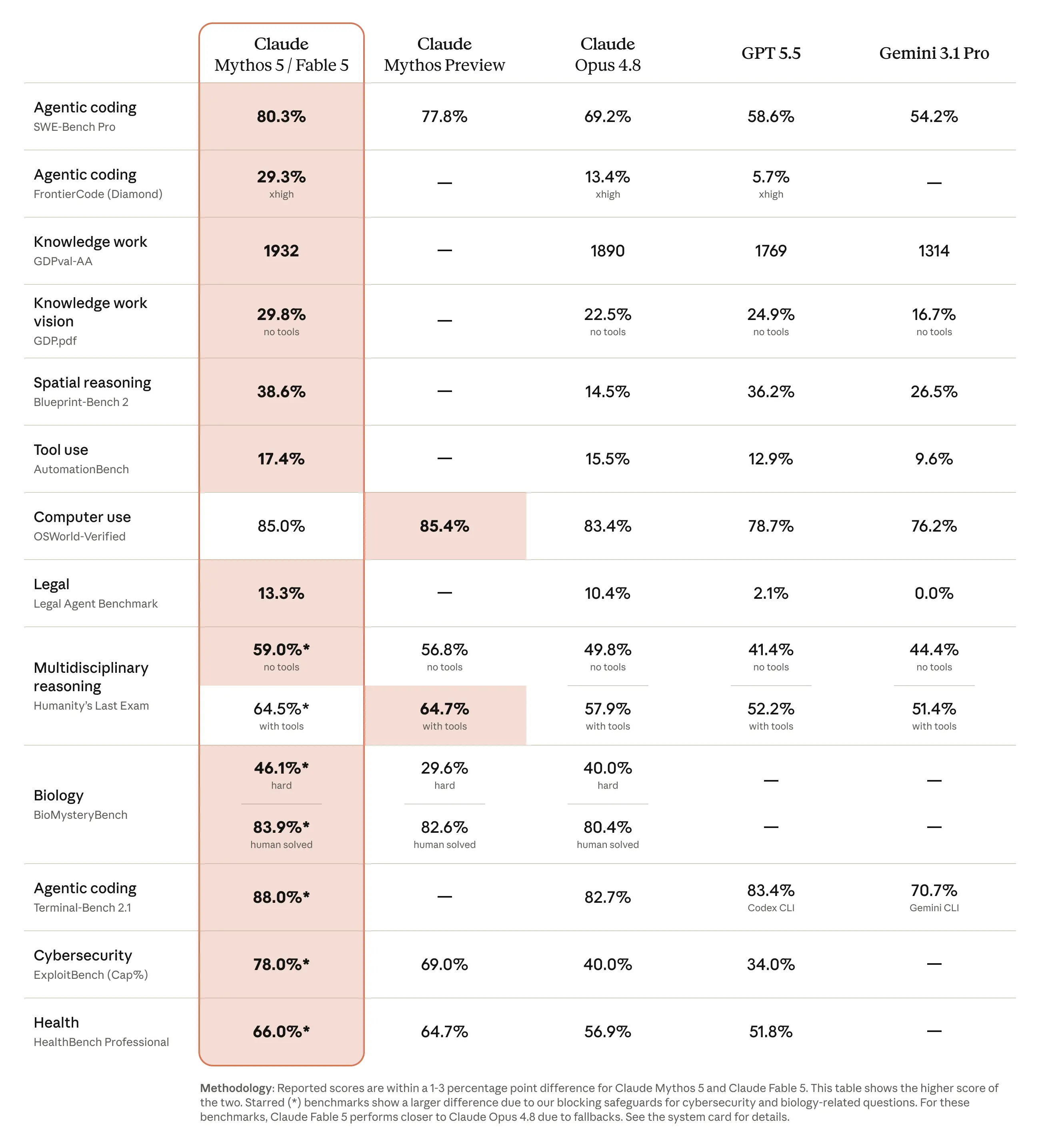
Key highlights include:
- SWE-Bench Pro (agentic coding): 80.3% — significantly ahead of Claude Opus 4.8 (~69%) and competitors like GPT-5.5 (~58.6%).
- FrontierCode Diamond: ~29.3% (with reports of higher scores in extended testing).
- Strong leadership in tool use, Terminal-Bench, CursorBench, OSWorld, and vision-enhanced tasks.
Independent evaluations confirm Fable 5's edge in software engineering, knowledge work, and multi-step reasoning. It outperforms prior models in real-world scenarios like large code migrations, UI design, game development, and scientific hypothesis generation. However, performance on some biology/chemistry or cyber tasks may route to safer fallbacks.
These results position Fable 5 as ideal for high-stakes professional use, where reliability over speed or cost is paramount. Prompt caching offers up to 90% discounts on repeated inputs, improving efficiency for iterative workflows.
Getting Started: Access and Setup
- Direct Anthropic Access: Create an account at console.anthropic.com, generate an API key, and add billing.
- Unified Access (Recommended for Production): Platforms like CometAPI offer one key for 500+ models, including Fable 5, with competitive routing, fallback logic, and usage analytics—eliminating the need to manage separate keys and endpoints.
Set your key securely:
export ANTHROPIC_API_KEY="sk-ant-..." # Or COMET_API_KEY for unified providers
Your First Claude Fable 5 API Call (cURL)
curl https://api.anthropic.com/v1/messages \
  -H "x-api-key: $ANTHROPIC_API_KEY" \
  -H "anthropic-version: 2023-06-01" \
  -H "Content-Type: application/json" \
  -d '{
    "model": "claude-fable-5",
    "max_tokens": 1024,
    "messages": [{"role": "user", "content": "Explain the key principles of idempotent API design."}]
  }'
Expect a response with content blocks, usage stats, and stop_reason.
Python Integration with Anthropic SDK
python
import anthropic
client = anthropic.Anthropic() # Reads ANTHROPIC_API_KEY

response = client.messages.create(
model="claude-fable-5",
max_tokens=2048,
system="You are a principal engineer. Be concise, use examples.",
messages=[{"role": "user", "content": "Design a retry strategy for flaky webhooks."}]
)

for block in response.content:
if block.type == "text":
print(block.text)
Pro Tip: For CometAPI users, swap the base URL . Replace api.anthropic.com/v1/messages with api.cometapi.com/v1/messages.
Advanced Usage: System Prompts, Streaming, and Tool Use
System Prompts for Consistent Behavior
response = client.messages.create(
    model="claude-fable-5",
    max_tokens=4096,
    system="You are a principal software architect. Prioritize clean, production-ready code with error handling and tests.",
    messages=[...]
)
Streaming for Better UX
Essential for long outputs:
with client.messages.stream(...) as stream:
    for text in stream.text_stream:
        print(text, end="", flush=True)
Tool Use (Function Calling) for Agents
Define tools with JSON schemas, handle tool_use blocks, and loop with tool_result responses. Ideal for autonomous coding agents.
tools = [
    {
        "name": "get_order_status",
        "description": "Look up the status of a customer order by ID.",
        "input_schema": {
            "type": "object",
            "properties": {"order_id": {"type": "string"}},
            "required": ["order_id"],
        },
    }
]

#Pass tools to the request  messages in the same way as you would pass parameters

messages = [{"role": "user", "content": "What's the status of order A1855?"}]

response = client.messages.create(
    model="claude-fable-5",
    max_tokens=1024,
    tools=tools,
    messages=messages,
)
When the model wants to use a tool, it returns stop_reason == "tool_use", a tool_use module containing the tool name and the selected input, as a response. The loop is simple: append the helper's response, run the tool, and then send the result back as a tool_result module in the new user's turn.
if response.stop_reason == "tool_use":
    tool_use = next(b for b in response.content if b.type == "tool_use")

    # Run your real function with the model's chosen input
    result = lookup_order(tool_use.input["order_id"])  # your code

    messages.append({"role": "assistant", "content": response.content})
    messages.append({
        "role": "user",
        "content": [{
            "type": "tool_result",
            "tool_use_id": tool_use.id,
            "content": result,
        }],
    })

    # Send the result back; the model now answers using it
    followup = client.messages.create(
        model="claude-fable-5",
        max_tokens=1024,
        tools=tools,
        messages=messages,
    )
The key detail lies in tool_use_id: the code block must reference the exact value of tool_result from another code block so that the model knows which call returned the result.
Adaptive Thinking
thinking={"type": "adaptive"},
output_config={"effort": "high"}
Tune effort for deeper reasoning on hard problems.
Comparison Table: Claude Fable 5 vs. Alternatives
| Model | Input/Output Price | Context | Coding Strength | Best For | Safeguards |
|---|---|---|---|---|---|
| Claude Fable 5 | $10 / $50 | 1M | Excellent (Mythos) | Agents, complex engineering | Strong (with fallback) |
| Claude Opus 4.8 | $5 / $25 | 200k+ | Very Strong | General high-intellect | Standard |
| GPT-5.5 Pro (est.) | Varies | Varies | Strong | Broad creativity | Different approach |
| Sonnet 4.x | Lower | 200k | Good | Speed/cost balance | Balanced |
(Data synthesized from public benchmarks and pricing as of June 2026.)
(Adapt based on real benchmarks; Fable 5 leads in sustained reasoning.)
Pricing, Cost Optimization, and Token Economics
Official Pricing: $10/M input, $50/M output. Expect higher effective costs on reasoning-heavy tasks due to longer outputs.
Optimization Strategies:
- Use prompt caching (where supported).
- Adaptive thinking/effort levels for balancing depth vs. speed.
- Fallback routing: Default to cheaper models, escalate to Fable 5 only for hard problems.
- Unified Platforms: CometAPI.com enables intelligent routing and often provides cost advantages or free tiers for testing, helping SaaS teams control spend without sacrificing access to frontier models.
Real-World Cost Example Table:
| Task Type | Est. Input Tokens | Est. Output Tokens | Direct Cost (Fable 5) | Notes |
|---|---|---|---|---|
| Simple Query | 500 | 300 | ~$0.02 | Fast |
| Complex Code Gen | 10,000 | 5,000 | ~$0.35 | Agentic |
| Long Agent Session | 200,000 | 50,000 | ~$4.50+ | Plan carefully |
Production Best Practices and Error Handling
- Implement retries with exponential backoff for rate limits (429).
- Monitor usage via Anthropic dashboard or provider analytics.
- Handle model fallbacks for safeguarded queries.
- Use structured outputs and validation for reliability.
- Scale with async clients and connection pooling.
Industry Insight: Enterprise CTOs report that unified APIs reduce integration debt by 70%+ and enable rapid model swapping as capabilities evolve. Platforms like CometAPI make this seamless.
Use Cases for Developers, Startups, and Enterprises
- Autonomous Coding Agents: Multi-file refactors, migrations.
- Enterprise Knowledge Work: Long-document analysis, simulation optimization.
- SaaS Features: Premium AI copilots, research assistants.
- R&D: Hypothesis generation, experiment planning.
Conclusion
The Claude Fable 5 API sets a new standard for capable, safe frontier models. By following this guide—starting simple, adding streaming and tools, optimizing costs, and leveraging reliable infrastructure—you can build production systems that deliverreal value today.
Ready to integrate? Head to CometAPI.com for instant access to Claude Fable 5 alongside the rest of the model ecosystem. Sign up, get your unified key, and start building smarter agents and applications now.
Last updated: June 2026. Always check official docs for latest details.
FAQ
What is the model ID for Claude Fable 5 API?
claude-fable-5
How much does Claude Fable 5 API cost?
Offical price is $10 per million input tokens and $50 per million output tokens. CometAPI's Price is $8 per million input tokens and $40 per million output tokens
Does Claude Fable 5 support tool use?
Yes, with excellent performance for agentic applications.
What is the context window?
1 million tokens.
What are the safeguards?
Sensitive queries (cyber, bio/chem) may fallback to Opus 4.8 automatically.
How does CometAPI help with Claude Fable 5?
Offering cheaper API access pricing. Provides a single OpenAI-compatible endpoint for easy access alongside other models, simplifying development and potentially optimizing costs.
Is there a free tier or trial?
Check Anthropic plans or unified providers like CometAPI for starter credits.
All rights reserved