


Building a Release-Evidence Ledger Before Trusting Any TTS Vendor Claim in a Pipeline
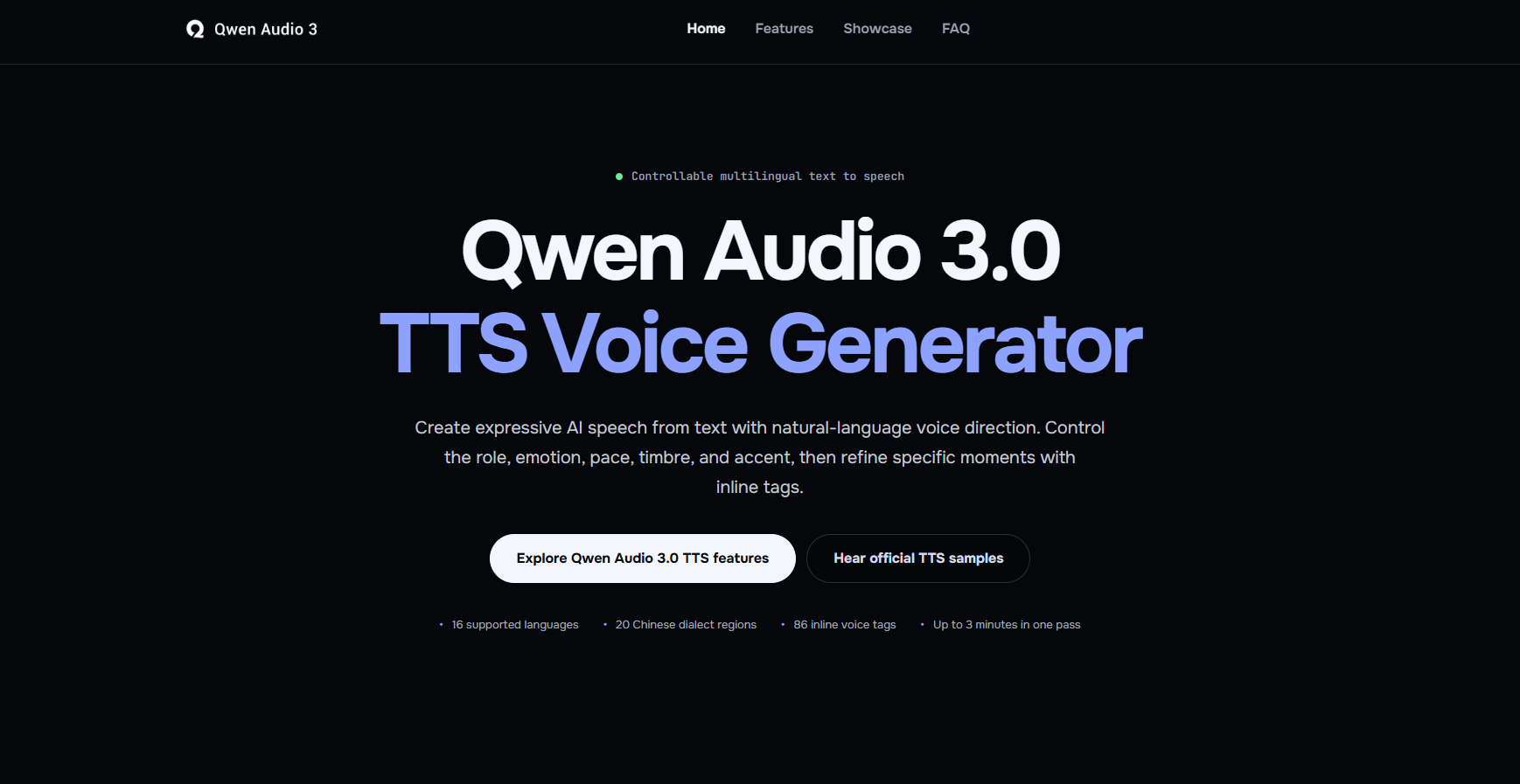
Official Qwen Audio 3.0 TTS product preview used as visual context for the review workflow.
The Problem: Vendor Claims Drift Faster Than Pipeline Documentation
When a text-to-speech vendor ships a version bump, most engineering teams update a config string and move on. That works until someone asks why a voice sample from last quarter no longer matches production output, or why a QA script flags a regression that turns out to be an undocumented model swap on the vendor side. The underlying issue is not audio quality. It is that TTS vendors change models, tiers, and default parameters on a cadence that most internal documentation cannot keep up with, and there is rarely a durable record of what was actually claimed at the time a decision was made.
This becomes a real constraint once TTS output feeds anything downstream: automated video narration, IVR prompts, accessibility layers, or QA regression suites that compare waveform or transcript output across releases. If the evidence for "why we picked this model" lives only in a Slack thread or a developer's memory, every audit, cost review, or vendor swap starts from zero.
The constraints for a workable fix are narrow. It has to be lightweight enough that a two-person team will actually maintain it, structured enough that a script can diff entries, and honest enough that it does not repeat marketing language as if it were verified behavior. It should also be vendor-agnostic, because the same problem recurs with every TTS or audio-generation provider a team evaluates.
Why a Static Comparison Sheet Fails
The first instinct is usually a spreadsheet: vendor name, tier, price, features, a column for "pros/cons." This fails for three reasons that matter in practice.
First, spreadsheets encourage copying vendor marketing copy verbatim, which means the sheet silently becomes an unverified claims log rather than an engineering record. Second, there is no timestamp discipline, so nobody can tell whether a row reflects the vendor's current product page or a description from eight months ago. Third, spreadsheets do not distinguish between a claim (what the vendor states), an observation (what your own test produced), and a decision (what you chose to do about it). Collapsing these three categories into one cell is how teams end up citing stale benchmark numbers as if they were current facts.
An alternative some teams try is embedding vendor comparisons directly into code comments near the TTS integration call. This keeps the note close to the code, but it rots the same way: nobody re-reads a comment once the integration works, and the comment has no structured field for "as of" metadata.
What actually holds up is a small structured ledger, checked into version control alongside the pipeline it informs, with explicit fields separating claim source, observation status, and decision rationale.
A Reusable Evidence Ledger Schema
Below is a minimal schema that has worked for tracking TTS vendor evaluation without turning into an unmaintained wiki page. It is deliberately plain YAML so it diffs cleanly in pull requests.
ledger_entry:
  vendor: ""
  product_url: ""
  claim_source: "product-page"      # product-page | changelog | direct-contact | third-party
  claim_text: ""
  claim_captured_at: "2026-08-01"
  verified_internally: false
  verification_method: ""           # e.g. manual listen, transcript diff, none
  tier_or_mode: ""                  # e.g. named tiers if the vendor exposes them
  decision: ""                      # adopted | rejected | pending-review
  decision_rationale: ""
  review_due: ""
Applied to a real evaluation, one entry might look like this. According to the product page for Qwen Audio 3.0 TTS, the tool supports multilingual text-to-speech generation with controls for emotion and pacing, and it presents a comparison between Plus and Flash modes along with audio samples. That description itself is the claim_text, sourced as product-page, with claim_captured_at set to the date the page was read, not the date the model was actually released. The verified_internally field stays false until someone on the team actually listens to generated samples and records the method used, not the vendor's own demo audio. Note that the ledger does not carry pricing, quota, or benchmark numbers unless there is a dated internal verification for them — an older cached product description is not sufficient grounds to treat those figures as current.
The tier_or_mode field matters specifically for TTS vendors that split capability across named modes, since a claim verified under one mode does not automatically transfer to another.
Verification Passes and Failure Branches
A ledger is only useful if it has a defined verification loop, not just a place to dump claims. A workable pass looks like this:
- Pull the current vendor page text for the relevant feature.
- Diff it against the last stored
claim_textfor that vendor entry. - If unchanged, extend
review_dueand stop. - If changed, create a new ledger entry rather than editing the old one in place, so history is preserved.
- Flag
verified_internally: falseon any new entry until someone runs an actual listening or transcript-comparison pass.
Failure branches are where most teams skip steps. If nobody owns step 2, the ledger becomes stale silently — it still exists, but every entry is trusted by default rather than by evidence. If step 4 is skipped and entries are edited in place, you lose the ability to answer "what did we believe on the date we made this integration decision," which is exactly the audit trail the ledger exists to provide. A third failure mode is treating vendor sample audio as internal verification; a sample reel curated by the vendor is a claim, not an observation, and should stay in claim_text, not in verification_method.
Tradeoffs and a Restrained Conclusion
The ledger approach has real costs. It adds a review cadence someone has to actually run, and on a small team that review is competing with feature work, so review_due dates slip unless they are tied to an existing sprint ritual rather than a standalone calendar reminder. It also does not solve the underlying problem of vendor drift; it only makes the drift visible and dated instead of invisible and assumed.
What it does provide is a defensible answer, months later, to why a specific TTS vendor or mode was chosen, and a clear separation between what a vendor states on a product page and what was actually confirmed. For any pipeline where audio output has downstream consequences — accessibility, automated narration, QA diffing — that separation is worth the modest maintenance cost. It is not a substitute for direct evaluation, and it should not be mistaken for one.
All Rights Reserved
